A Place for Zero by Angeline Sparagna LoPresti
A Place for Zero
Reviewed By: Andrew Rubino
Author: Angeline Sparagna LoPresti
Illustrator: Phyllis Hornung
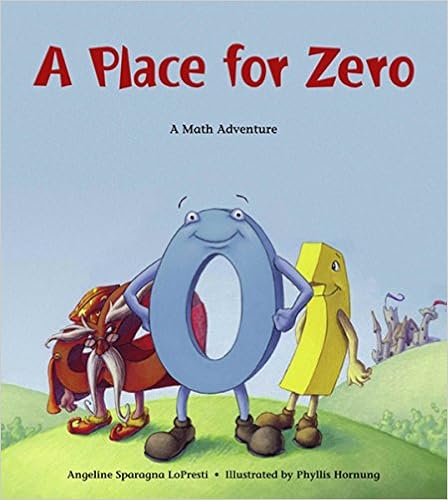
Recommended Grade Level: 1st Grade
Content
Standards:
CCSS.MATH.CONTENT.1.NBT.B.2.B
The numbers from 11 to 19 are composed of a ten and one, two, three, four, five, six, seven, eight, or nine ones.
The numbers from 11 to 19 are composed of a ten and one, two, three, four, five, six, seven, eight, or nine ones.
Common
Core Standards for Mathematical Practice:
Make sense of problems and persevere in solving them.
Summary:
“A place for Zero” by Angeline Sparagna LoPresti is about a lonely number
named Zero and his adventure to discover his place in Digitaria. Zero constantly finds himself alone because
other numbers could play Addemup, but he could not. Zero never had anything to add. Zero starts his adventure at Count Infinity’s
workshop. There he discovers he can be
used in the Numberator machine that adds two numbers together to create a new
number. In Zero’s case he can be used to
create additional 1s. Inspired by his
newly found additive identity, zero becomes curious about his role in
multiplication and so he goes to visit King Multiplus. The King becomes curious and so he attempts
to multiply Zero with other numbers. To everyone’s
astonishment, every outcome always led to more zeros. Zero pushed on and found himself standing
next to his other number friends and realized he could create numbers that
nobody in Digitaria has ever seen before.
Zero could create numbers like 10, 100, or even 1000! Zero didn’t have any problems playing Addemup
with his friends ever again.
Rating:
I give this book a 5/5 rating. A Place for Zero is an exciting adventure that will really draw students into the story. The book contains a vast amount of mathematical lessons to be taught such as multiplication and number placement. The book also sends a strong message to children about involving everyone in activities, and not letting anyone be alone.

Classroom Ideas:
1) Students can create the number given
using counter cubes, and then discuss the different methods used to get to the
number. For example: two possible ways to get to the number 12, students can
group 1 ten and 2 ones, or 12 ones.
2) Students will be given different digits
from 1 to 9. Ask students to calculate how many different combinations of
numbers it is possible to create from these digits. Students will record their
findings to keep track of their answers and share with the class.
3) Introduce/review vocabulary words like
combination and infinity. In the book, there is a great visual example of what
happens when you put the number one next to the number zero. There are also
examples of placeholders involving the ones and tens.
4) Students will be grouped and given a
pair of dice and counting cubes. Students will be reminded of the “Addemup”
game that Zero couldn’t play in the beginning of our story. Students will be
instructed to create their own game with the materials, and then asked to share
their games with the class. At the closing of the lesson, Students will be
reminded of the value of teamwork. This will connect their team building
exercise of creating a game together with the accomplishments of Zero when he
worked together with his fellow numbers to create new numbers.


Your idea to have students create a game of their own is great! Not only is it creative, it reinforces learning this math concept in an organic way. The secondary lesson of teamwork is also a valuable one.
ReplyDeleteAndrew,
ReplyDeleteThe title of this book alone caught my attention. I have rarely seen books that focus on the number zero. Books usually just focus on numbers such as 5, 10 , or a 100. I think during kindergarten and first grade, it is very important to have students understand that zero is an important number. Your fourth classroom idea would be great to implement in a classroom. It will give students the opportunity to work in groups and understand why zero was an important number/character in the book.
Hello Andrew,
ReplyDeleteI think this is a really great book! Children at the age of first grade usually think that 0 is not a number and tend to forget about it. This book, along with your activities will really help them understand the number 0 much more so that they can use it with more consideration!
I agree with many of your ideas that you posted in your entry. In class, you spoke about this book in a small group and I found this book to be very interesting! I like your classroom ideas such as when you said "Students can create the number given using counter cubes, and then discuss the different methods used to get to the number."
ReplyDelete